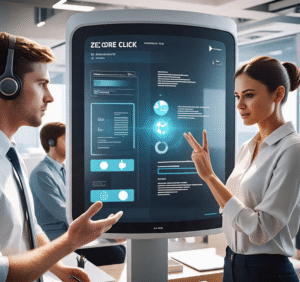
As digital experiences become more intuitive, frictionless, and personalized, a new frontier is emerging in the world of customer relationship management: Zero-Click CRM. Imagine a world where customers no longer have to fill out forms, click buttons, or navigate complex menus. Instead, they interact with brands through natural voice commands, facial expressions, and even subtle gestures — all captured, interpreted, and responded to by intelligent CRM systems. It may sound futuristic, but it’s closer than you think.
Zero-Click CRM refers to the evolution of customer engagement into a hands-free, touch-free experience. It’s built on a foundation of voice recognition, gesture tracking, biometrics, and AI-driven context awareness. In this model, the customer doesn’t need to manually input data or click through pages. Instead, the CRM system anticipates needs, responds to verbal or physical cues, and offers assistance proactively.
The rise of smart assistants like Alexa, Siri, and Google Assistant has already trained users to expect voice-based convenience. Meanwhile, advancements in computer vision and motion detection — seen in everything from gaming to security systems — are pushing gesture recognition into the mainstream. Together, these technologies are setting the stage for a CRM revolution.
Picture this: a customer walks into a retail store. Facial recognition technology identifies them (with prior consent), accesses their CRM profile, and prompts a store associate with personalized recommendations. At home, the same customer could ask their smart speaker to check delivery status, schedule a return, or get support — all without logging into an app or clicking a single button.
This shift has profound implications for user experience. Zero-click interaction removes friction and makes digital engagement more accessible — particularly for elderly users, people with disabilities, or anyone seeking speed and convenience. It also opens up opportunities for emotional intelligence in CRM, as systems detect tone, mood, and gestures to tailor responses in a more human-like manner.
But the transition to Zero-Click CRM is not without challenges. Privacy and data security are major concerns. Voice and gesture data are highly sensitive, and customers must trust that their biometric and behavioral information is handled responsibly. Transparency, opt-in mechanisms, and robust data protection protocols will be critical to adoption.
Another challenge lies in context awareness. For Zero-Click CRM to be effective, it must understand the user’s intent with high accuracy. Misinterpretations can lead to poor experiences or even reputational risk. Continuous improvements in natural language processing (NLP), machine learning, and sentiment analysis will be essential for building trust and usability.
Despite these hurdles, the potential is enormous. Brands that embrace Zero-Click CRM early will gain a competitive edge by offering futuristic, seamless experiences that reflect how people increasingly want to interact — naturally and effortlessly.
In conclusion, the future of CRM may very well lie beyond the screen. As voice and gesture technologies become more refined and integrated into daily life, CRM systems must evolve to meet customers where they are — not through clicks, but through conversations, expressions, and presence. Zero-Click isn’t just a user interface trend; it’s the next chapter in customer-centric innovation.